

How much income can we have in 2027 and keep the ACA subsidy?
In 2027 a married couple can have up to $86,560 of income and keep the ACA premium tax credit. Which accounts you spend from decides most of it.


If you’ve retired before 65 or will soon, HealthCare.gov asks you to estimate your 2027 income, because that estimate sets your credit during the year on a marketplace plan, the kind sold under the Affordable Care Act. Once you stop working, there’s no pay stub to copy that number from.
I went through a version of this myself. During my 20 years at J.P. Morgan, open enrollment came around every fall and my employer covered most of the cost. When I started my own firm, I turned to the marketplace for the first time to cover my family. I didn’t expect how involved it would be or how much your income can change what you pay.
The credit is paid to your insurer each month and lowers your premium. Below the $86,560 income line, you pay no more than 10.22% of your income for the benchmark plan. That’s the second-cheapest silver plan sold where you live. The credit covers the rest of its price. Above the line, you pay full price for whatever plan you choose.
For a couple with $2 million or more in investable assets, staying under that line depends less on how much you spend than on which accounts you draw that spending from.
Where the line sits for 2027
The line is 400% of the federal poverty guideline. For 2027 coverage that’s the 2026 figure of $21,640 for a household of two. Four times that is $86,560. For one person the line is $63,840.
The line came back in 2026 because Congress didn’t extend the larger credits that ran from 2021 through 2025. If an extension becomes law, these numbers change. Until then they’re the numbers to plan around. Open enrollment on HealthCare.gov runs through January 15, 2027. Choose a plan by December 15 for coverage that starts January 1.
What counts as income for this test
The test uses your modified adjusted gross income, which is the adjusted gross income on your tax return with a few items added back.
What counts toward the line
- The taxable part of withdrawals from a traditional IRA or 401(k)
- Roth conversions, which move money from a traditional IRA into a Roth IRA
- Gains you take when you sell investments, plus the gains mutual funds pay out at year end
- Dividends and taxable interest
- Municipal bond interest, even though it’s tax-free
- All of your Social Security, taxed or not
- The taxable part of a pension
- Wages, self-employment income and net rental income
What doesn’t count
- Spending from cash or bank savings
- Tax-free Roth withdrawals
- What you originally paid for investments you sell
- Your assets, your home or your net worth
Greg and Lisa’s savings use up room before they withdraw a dollar
Let’s use an example with Greg and Lisa. They’re 62 and 60, retired in the Myrtle Beach area and not yet claiming Social Security. They plan to spend $120,000 in 2027. Their taxable account will pay about $14,000 in dividends, interest and fund payouts whether they touch it or not. The rest of their savings sits in traditional IRAs and a smaller Roth.
That $14,000 counts toward the income line before they withdraw anything. Many mutual funds pay out capital gains in December whether or not you sold anything.
None of that is a reason on its own to sell those holdings. It does mean the room under the line is smaller than $86,560 before you spend a dollar.
What crossing the line would cost them
In Horry County, which includes Myrtle Beach, the benchmark plan for a couple Greg and Lisa’s ages costs about $34,400 a year in 2027 at full price.
At $86,560 of income they’d pay about $8,850 toward that plan and the credit would cover about $25,600. At $86,561 the credit is zero.

I know that’s a hard number to look at when you’re spending from savings.
If you spent your career at a large company, you may never have seen a number like that. In 2026 the average family plan at a large firm cost about $28,600 and workers paid about $6,800 of it, according to KFF. The company paid the rest where you didn’t see it. HR counts that as part of your total compensation and it is. You just don’t feel the full price until you’re the one buying the plan.
Same spending, two different bills
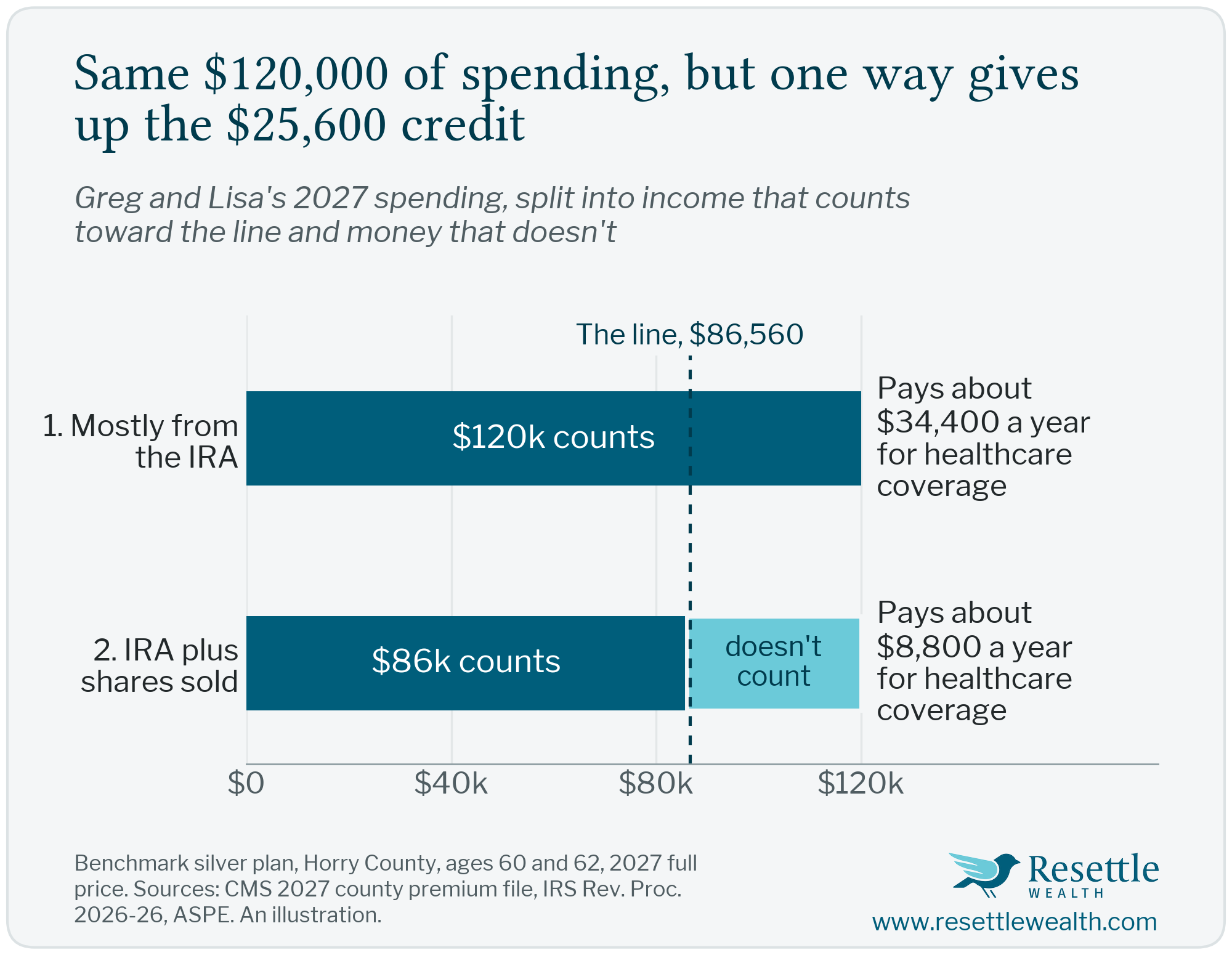
Greg and Lisa could cover the year two ways.
Only the $12,000 of gain on the shares they sell counts toward the line. That leaves their income about $560 under it, so the second way saves them about $25,600 on health coverage. The only change is which accounts pay for their spending. Paying this way also means less income tax this year, though the money left in the IRA is still taxed when it comes out later.
To me, that’s the biggest change from working at a large company. There, open enrollment was mostly about picking a plan. On the marketplace, what you pay depends on your income, so the planning starts long before you pick one.
What this means for Roth conversions
The usual window for Roth conversions runs from the year you stop working until Social Security and the withdrawals the IRS requires in your 70s push your income back up. You pay tax on the money now and it comes out tax-free later. That’s worth doing when those dollars would otherwise face a higher tax rate. When you pay tax on your savings can matter as much as when the market rises or falls.
If you’re on a marketplace plan with the credit, the years before Medicare are often the costly stretch of that window. Under the income line, the credit shrinks as income rises, usually by 10 to 20 cents per dollar, on top of the income tax. A smaller conversion can still fit under the line if it replaces an IRA withdrawal and your taxable account covers your spending.
In the second way, Greg and Lisa are about $560 under the line, so adding a $20,000 conversion would cross it. If those dollars would be taxed at 22% later and 12% now, the conversion saves about $2,000 in tax and costs about $25,600 of credit.
To me, the costly mistake is crossing the income line by a little.
A larger conversion climbs into higher tax brackets, so each added dollar saves less. Looking at tax rates alone, if those dollars would be taxed at 24% or less later, no single year’s conversion for Greg and Lisa, at any size, saved enough tax to make up for the lost credit.
For many couples on the credit, the better years for larger conversions come after Medicare starts and before Social Security does, when there’s less credit to lose or none at all. Medicare raises its premiums at higher incomes, so those conversions still need sizing.
If your income is over the line anyway or your IRAs are very large, the years before Medicare can still make sense. It’s a decision to make year by year, with your own numbers in front of you. Working through that choice each fall, before open enrollment, is part of how we help retirees plan around their taxes.
What happens if your income comes in higher than you estimated
When you file your 2027 taxes in 2028, the advance credit paid to your insurer is checked against the income you actually had. If your income comes in higher but stays under the line, you pay back only the difference in credit. If your income lands over the line, you pay back the whole advance credit. For Greg and Lisa, that’s about $25,600 due with their tax return.
With only $560 of room, a December fund payout bigger than expected, the taxable gain on a home sale or a conversion decided in November can cost the whole year’s credit. A conversion can’t be undone. If your estimate changes, update your application on HealthCare.gov as soon as you know, so less comes due at tax time.
When this doesn’t apply
- If either of you can get TRICARE or affordable coverage through a current job, that person usually can’t get the credit, even if you turn it down.
- If one of you is already on Medicare, your joint income still sets the credit. It covers only the spouse on the marketplace plan.
- If you estimate income under $21,640, you get no credit. In North Carolina, which expanded Medicaid, that cutoff is about $29,860.
What to do before December 15
I’m working through these same steps for my own family this fall.
- Open last year’s tax return and find your interest, dividends and capital gain distributions. Start your 2027 income estimate with them, since payouts like these tend to repeat.
- Add everything else the marketplace counts as income, from the list above.
- Price your plan on HealthCare.gov twice, once at your expected income and once at full price. The difference is what staying under the income line is worth to you.
- Decide which accounts will pay for your 2027 spending before you enter your income estimate.
- Talk with your CPA about any conversion, home sale or large gain planned for 2027.
Joshua Hemmert, CFP®
Joshua Hemmert is a CFP® professional and the founder of Resettle Wealth, bringing more than 20 years of institutional retirement and investment experience to families making the turn from saving to spending.
When he is not working with clients, you will find him baking chocolate chip cookies with his kids or watching college basketball in March.
More Insights
Let’s Find Out Where Your Retirement Stands
A 45-minute video call about your situation and the questions on your mind. There’s nothing to prepare, no cost and no obligation.